The Evolution of the Yucca Valley Film Festival
By Crystal Harrell
When the Yucca Valley Film Festival (YVFF) launched eight years ago, it wasn’t designed to chase trends or replicate the prestige of big-city festivals. Instead, it grew organically from the desert itself: its people, its history, and its long-standing creative undercurrent.
“There has always been a strong artistic community here, with many artists and film professionals living in the desert,” co-director and founding co-creator Matt Beurois explains. “The festival didn’t invent that culture. It gave it a stage.”
Yucca Valley’s cinematic DNA runs deeper than many might expect. Beurois points to the legacy of nearby Pioneertown and a movement just before the festival’s launch that felt almost symbolic.
“Shortly before we launched the festival, Tim Burton filmed a scene from Miss Peregrine’s Home for Peculiar Children at the local Circle K,” Beurois recalls. “Film culture has long been part of the landscape here and YVFF was built on that foundation to bring people together.”
While the desert setting was essential, the festival’s early success hinged on trust and community buy-in. “It succeeded because residents felt they were part of it,” says Beurois. That trust came quickly.
Support from then-Mayor Dr. Robert Lombardo and City Manager Curtis Yakimow established a strong foundation, as did backing from the Community Services Manager Sue Earnest, giving the fledgling festival the confidence to move forward for its first and second year.
“What ultimately made the difference was that people showed up for the first edition of the festival,” Beurois says. “That’s easy to say after eight years of the same, and great, international films, and a marvelous list by Midnight Express curator and co-director John Stanier established a successful film festival structure, but not out of place.”
“It was the right balance of ambition, excitement, and entertainment,” Beurois says, noting that despite being a small town, “Yucca Valley rose to the occasion.”
“Most importantly, the community filled the room throughout the entire event. That response proved the appetite was real.”
Beurois and festival co-founder Aeyron were not newcomers to cultural production. “We had been organizing cultural events and film festivals and working in the film industry for about ten years at that point,” he explains, and from the beginning, YVFF was “conceived to serve and entertain the local community and to give it something to take pride in.”
Independent filmmakers quickly became the heart of the festival. “Independent filmmakers are our core guests and always have been,” Beurois emphasizes. “YVFF does not impose themes or curated requirements. We still consider any filmmaker if the film is strong and brings something interesting, enjoyable, surprising, or beautiful to audiences.”
According to Beurois, however, one thing has never changed: the relationship with the town. The main descriptor YVFF’s early days is still valid.
“We had to create a brand and build an event from scratch,” he says, from establish and maintain a reputation year after year. “Nothing comparable to YVFF has emerged in the Hi-Desert since, simply because it is a massive amount of work.”
The commitment is ongoing. Beurois spends 10 to 11 months out of every year planning the next edition, and since 2019, it’s never stopped. “It’s a lifestyle commitment,” he says.
Over time, the festival’s outward appearances has evolved—its structure remains familiar—its awards event with a number of screenings and appearances. Now it also offers not only the longest red carpet in the Hi-Desert, but expanded programming and a full “best festival community” event, as well.
Despite its growth, the festival’s core values remain unchanged. “Our residents and the local community is family,” Beurois says. “We are not going to change this idea. We didn’t try to change life in the desert. We just created an event that reflected its rhythm and gave it what makes this place special.”
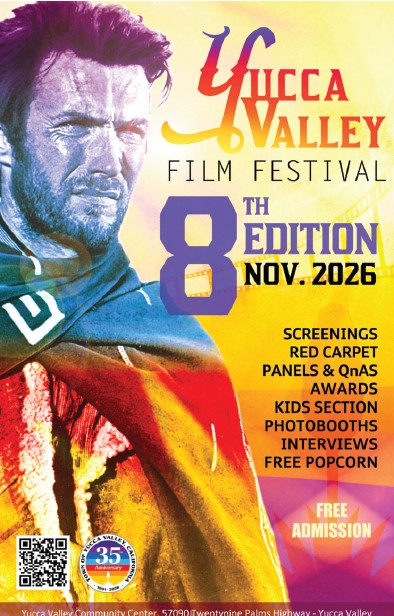
This November 5–8, the festival celebrates its 8th year to sell out. It’s check out the lineup of offerings, from film screenings to Q&As, panels, a kids’ edition, and photo booths—a destination and a place to call home.