
Lessons in Change and Harmony
By Ken Lee
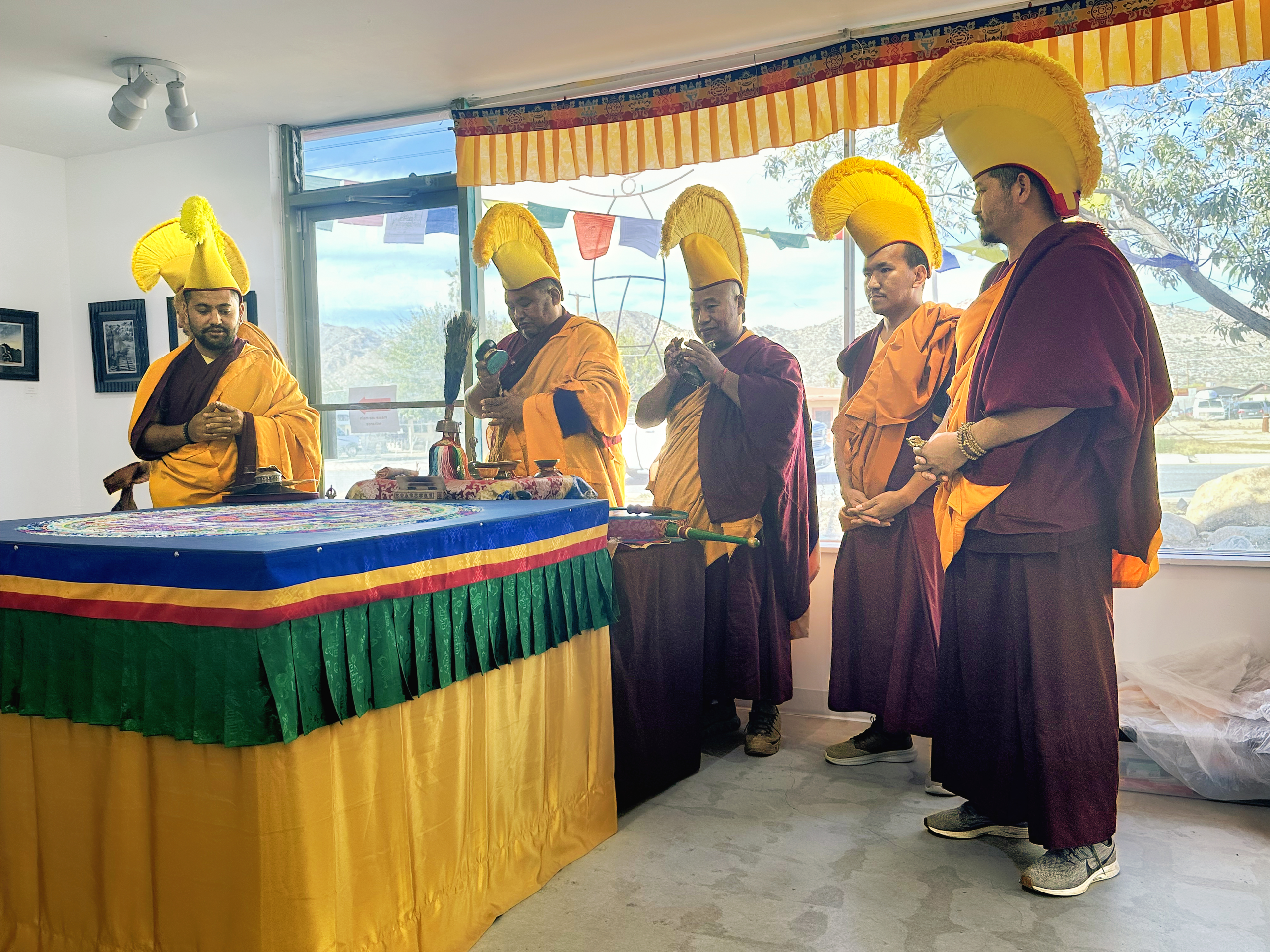
The notion of impermanence can seem like a lofty idea. We knock on a table. We talk to a friend. We hold Yucca Brevifolia Magazine in our hands. All of this seems permanent enough. Yet, when we attended a Tibetan dissolution ceremony at Hi-Desert Arts in Yucca Valley, we’re reminded why understanding that all things are temporary can help us live more fully.
The Gaden Shartse monks spent many days at the arts gallery, painstakingly creating a beautiful and intricate Tibetan sand mandala dedicated to Manjushri, the Buddha of Supreme Wisdom, forming it grain by grain. Crafted with vibrantly-colored geometric patterns, the mandala was a visual expression of how wisdom ushers in harmony to meet chaos in the universe. Then, the monks brushed it all away in the dissolution ceremony. It was impermanence made visible.
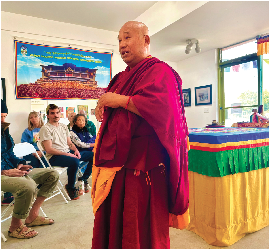
As one of the monks pointed out, the most important reminder of this lesson is to make the most of our lives while we’re here. “We should try to make a positive impact for ourselves and those around us,” one told me. It was a reminder that everything is temporary, and wisdom, according to Buddhism, arises from understanding that change. The monks’ mesmerizing prayers echoed this understanding.
Afterward, the monks carefully packaged the scattered sand into small plastic bags and gave one to each person in attendance. The remaining sand was taken to Joshua Tree Lake where it was released to spread its blessings and peace back into the world. This was wisdom dissolving back into nature to create harmony.
Seeing the dissolution ceremony near our home felt like a full circle event for me and my wife. We had met in a support group for Tibetan people and culture, and through our work with Tibetans, we attended meetings, vigils, protests, ceremonies, and Losar (Tibetan New Year) celebrations. At several of these events, we met Geshe Gyeltsen, the founder of Thubten Dhargye Ling in Long Beach, California—one of the oldest Tibetan Buddhist centers in the West —along with many other members of the Tibetan community. Gyeltsen was a Tibetan Buddhist monk trained for 20 years in the traditional Geluggeshe system and studied at Gaden Monastery’s Shartse College near Lhasa before leaving Tibet. He later became a teacher and human rights activist in the United States. This was a far cry from Yucca Valley, where we had just witnessed monks from Gyeltsen’s monastic lineage create the mandala.
Geshe Gyeltsen at the Global Day of Action
on March 31st, 2008. Photo Courtesy of Ken
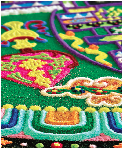
A closeup of the detailed sand mandala at
Hi Desert Arts in Yucca Valley. Photo
Courtesy of Ken Lee.
These monks had traveled from India, not Lhasa, however. Gaden Monastery now exists in Mundgod, Karnataka, in South India. In 1959, the Chinese military invaded Tibet, forcing many Tibetans to flee across the snowy Himalayas into India. Despite crushing poverty, India opened its arms to approximately 100,000 Tibetan refugees. Many settled in the Himalayan regions, while others, such as the monks of Gaden Monastery, resettled in South India.
Although we never visited Gaden Monastery itself, my wife Lisa and I traveled extensively to other Tibetan settlements and monasteries in South India, Himachal Pradesh, Dharamsala, Ladakh, and areas near the Ganges River, including Mussoorie and Dehradun. In some ways, the expansive Himalayan Mountains where Buddhism was born share something in common with the desert. Sparse landscapes, extreme weather, and vast skies mirror Buddhist insights about transience, nonattachment, and looking beyond the self. Their silence and broad space encourage contemplation.

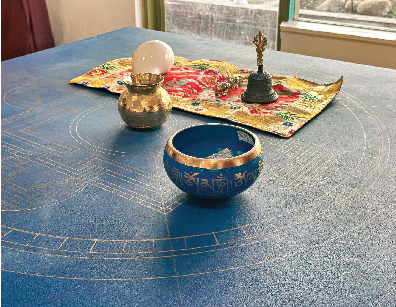
A small bag of the grains of sand from the
sand mandala, which I have displayed in my
room in my house in the high desert. Photo
Courtesy of Ken Lee
I have no doubt this is why the desert attracts so many artists, drawn by its vastness, its ability to strip life down to essentials, and its invitation to deep reflection. And the lessons offered by Buddhism can have very practical benefits, whether one identifies as Buddhist—or a creative— or not. In the United States, mindfulness, for example, is used by millions for stress reduction, mental health, and focus. Paying attention to the present moment, rather than dwelling on the past or worrying about the future, can reduce stress and bring clarity and calm. Embracing impermanence can also cultivate gratitude for what we have, anchor us in the present, and foster a healthier relationship with uncertainty.
And, as the monks at Hi-Desert remind us, these lessons ultimately help us make a positive impact— for ourselves and for those around us.