
Protecting the Magic that is Joshua Tree
By Jacqueline Guevara
Holding positive energy. Find a corner of the park where you can be alone for a few minutes, and it’s easy to feel those peaceful, calming vibes, even today.
In the early 1930s, Minerva Hamilton Hoyt, a wealthy socialite from Pasadena, noticed that several of her well-to-do neighbors were visiting the desert and poaching native cacti and other plants. As a member of the Pasadena Garden Club, and a frequent visitor to the desert herself, Minerva was concerned about the future of desert plants in the area—and took action.
Dubbed “The Apostle of the Cacti,” she used her considerable wealth and privilege to influence then-President Franklin Delano Roosevelt to designate 825,000 acres of the Mojave and Colorado deserts as Joshua Tree National Monument. In 1994, the monument was redesignated as Joshua Tree National Park.
Over the years, boundaries have morphed and the size of the park has slightly diminished, but one thing has remained constant: the need to protect and steward the land. The lands inside the park have indeed been set aside in alignment with the National Park Service’s mission statement to “preserve unimpaired the natural and cultural resources” therein “for the enjoyment, education, and inspiration of this and future generations.” But, as the saying goes, it takes a village to fulfill that mission—and that’s where the Joshua Tree National Park Association (JTNPA) comes in.
The Joshua Tree National Park Association is one of several local nonprofit organizations that partner with Joshua Tree National Park to provide support for the park’s programs, projects, and personnel. Charged with staffing, stocking, and managing Joshua Tree’s six visitor centers and park stores, operating park-centered educational programs like the Desert Institute and Discover JTREE, as well as conducting membership, fundraising, and “friend-raising” efforts, the JTNPA is uniquely situated to continue the work begun by Hamilton Hoyt: to help protect the native flora, fauna, and land itself, while educating and inviting others to become stewards of the desert.
Founded in 1962 as the Joshua Tree Natural History Association, the JTNPA, in its current incarnation, began in 1994. Since then, the organization has donated tens of millions of dollars in in-kind support and cash donations to the park, with roughly $4 million contributed in 2025 alone. A team of only 50 employees powers this small but mighty organization, which relies on its community partners, members, and donors—known as Park Lovers—to shop, donate, participate, and volunteer to make these meaningful contributions possible.

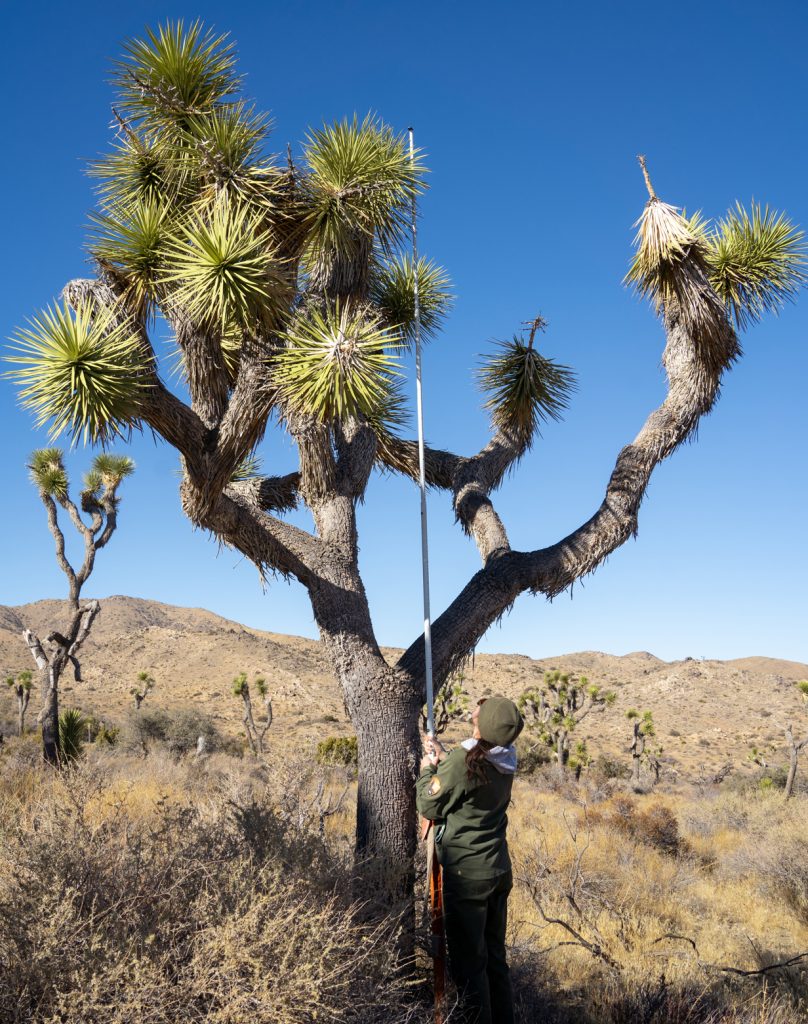
JTNPA-funded projects like Desert Plant Restoration enable park staff to gather, store, and study Joshua tree seeds while collecting data on how rising temperatures and changing environmental conditions impact the park’s iconic plant. This work is supported in part by Minerva Hamilton Hoyt’s own Pasadena Garden Club.
Meanwhile, Desert Bighorn Studies have allowed researchers and scientists to map the movement of the park’s herd, which is now at approximately 10% of its historic size. Based on the data collected, the park has closed popular hiking trails during the summer months, enabling the herd to access critical watering holes freely and with minimal disturbance.
The Tortoise Tracking Program has similarly provided park staff with valuable insights into tortoise movement patterns while helping monitor the health of the population. That information, in turn, informs important habitat preservation decisions.
The JTNPA also funds elementary school field trips and distance learning programs so that future generations of public land stewards have the opportunity to visit Joshua Tree National Park and engage with the remarkable desert landscapes that call it home.